
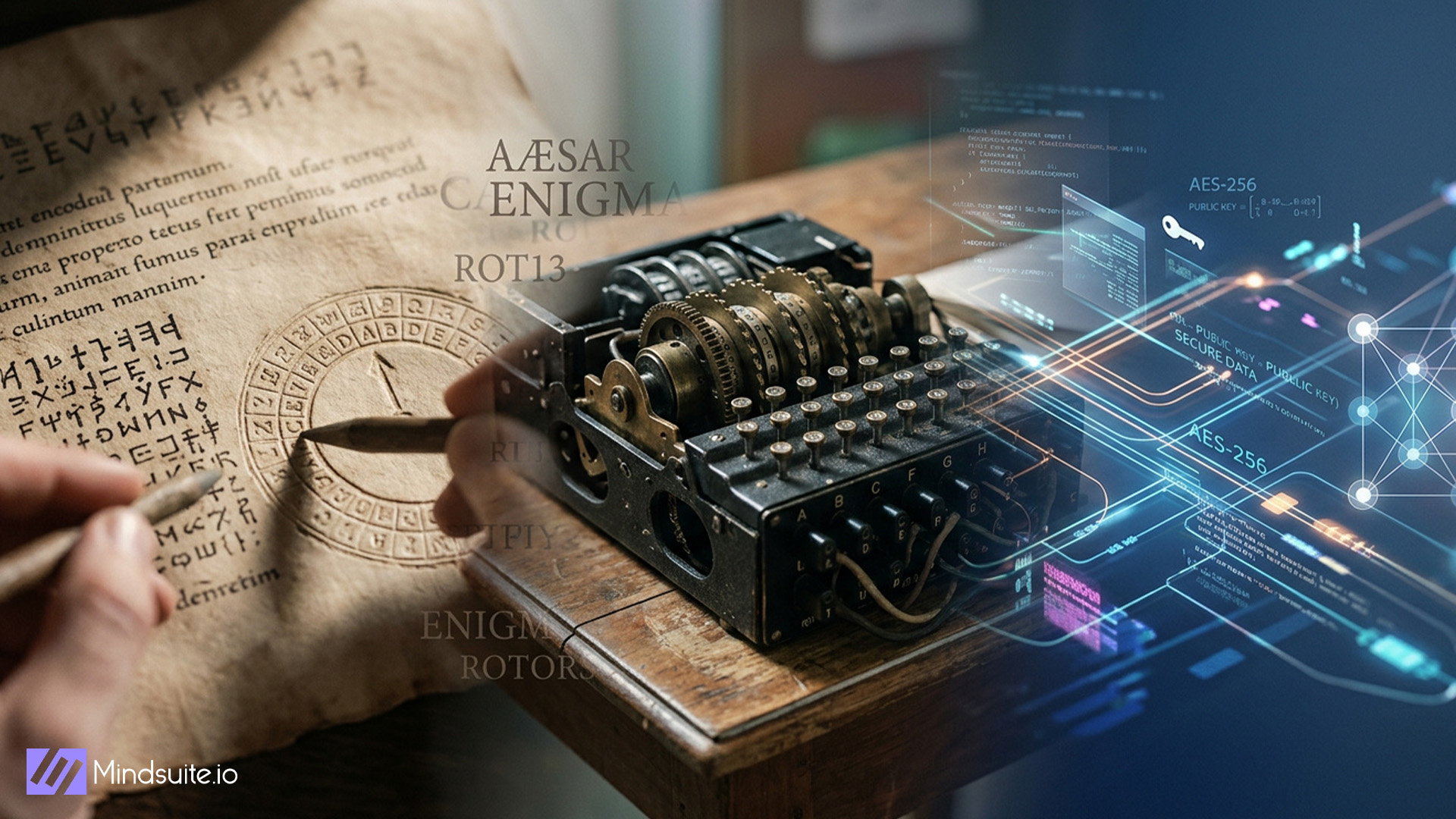
You would be hard-pressed to find the origins of encryption in today’s world. The practice is much older than that. Even in early times, people knew you had to put some safeguards around sensitive information when war or political strife was likely.
Take the Caesar cipher, for instance. It is perhaps the best known of the old ways, a straightforward letter-shifting contrivance Julius Caesar used for his military correspondence. In an age before modern technology, it may have been elementary, but it put forward a compelling notion: turn plain text into something coded.
Naturally, things have progressed well past such simple substitution. With the shift from a handwritten letter to digital dealings, so too have the cybercriminals. Now whether you are a government, a business, or just an individual, you depend on robust encryption for your passwords, private chats, and financials.
The FBI has it on record in their reports that global losses from cybercrime are climbing year in and year out, which says enough about the importance of having good security these days.
In this blog, we will look at how we have come from the days of the Caesar decoder to the sophisticated systems that keep our data safe.
Understanding the Caesar Cipher
You could call the Caesar cipher the most venerable of encryption techniques. It is named for Julius Caesar, the Roman general who put it to use as a means of keeping his military’s confidential business from falling into enemy hands. In its day, the method was as effective as it was straightforward: you would take every letter in your communication and move it along the alphabet by a set number of places.
Take a shift of three as an illustration. An A is made into a D, B into an E, C into F. By those rules “HELLO” is rendered “KHOOR.” Without knowing the shift pattern, you couldn’t make sense of what was written.
Why the Caesar Cipher Was Revolutionary
You might think of the Caesar cipher as a primitive thing in light of today’s encryption, but it put forward a novel concept: that you could conceal your information by way of transformation. Prior to such a system, anyone could intercept anything put in writing.
What the cipher showed was that having a code could be an asset on the military or political front. In a broader sense, it was the starting point for all the encryption systems to come, the ones that have since become the backbone of modern cybersecurity.
The Rise of Substitution Ciphers
With the proliferation of communication came a rise in security problems. It did not take long for people to see that the Caesar cipher was an easy mark; an attacker could run through all the shift values quickly. Such a vulnerability put pressure on cryptographers to come up with something more sophisticated, namely the substitution cipher.
The decoder for this type of cryptography is of a different order. Rather than a straightforward alphabetical shift, you are dealing with a custom pattern for each letter’s replacement. You might have an A turn into a Q and a B into a T, for instance.
Why Substitution Ciphers Improved Security
With the advent of substitution ciphers, they made encryption far more complex. You had the Caesar cipher with its handful of shift options, but a substitution system would offer thousands of different arrangements. Decoding such messages by hand was no simple task. It is little wonder that governments and their military or diplomatic arms came to depend on these systems for any communication they wanted to keep confidential.
Encryption During Wartime
You could say that the First and Second World Wars were a time of swift progress for encryption. The impetus came from governments who had to put in place secure systems to shield their military operations, whether it was safeguarding plans and intelligence or keeping communication on the battlefield confidential. Over those years, cryptography made the leap from being done by hand with rather basic means to something driven by machines.
The Enigma Machine and Advanced Wartime Encryption
The German Enigma machine is perhaps the best known of all wartime encryption contraptions. It was a far cry from an ordinary substitution cipher; with its rotating parts, the Enigma would alter its patterns on a constant basis. You pressed a key and the encryption would shift with it, which is what made the task of decoding such an arduous one for the Allies. In all, the device put up millions of combinations to stymie their cryptographers.
It took the efforts of British mathematician Alan Turing and his people to get around those Enigma codes. What they did was instrumental in advancing the field of computational cryptography and is regarded by many as a true turning point in the Second World War.
The Shift from Mechanical to Digital Encryption
The invention of computers transformed encryption forever. Digital communication created new risks because data could move instantly across networks.
As businesses adopted email, online banking, and cloud systems, stronger encryption became essential.
The Emergence of Modern Cryptography
Modern cryptography uses mathematical algorithms rather than simple letter substitutions.
Key developments included:
- DES (Data Encryption Standard)
- RSA (Rivest–Shamir–Adleman) encryption
- AES (Advanced Encryption Standard)
- Public key cryptography
Unlike traditional ciphers, modern encryption can secure enormous amounts of data in seconds.
Understanding Public Key Encryption
One of the most significant challenges in traditional encryption was securely sharing secret keys. If attackers intercepted the key, they could easily decode sensitive information.
Public key encryption solved this problem by introducing a two-key system.
How Public Key Encryption Works
Public key cryptography uses two separate keys:
- A public key for encryption
- A private key for decryption
Anyone can use the public key to encrypt a message, but only the private key owner can decrypt it.
Why Public Key Encryption Changed the Internet
You could say public key encryption is the backbone of internet security as we know it today. It is what makes secure websites and digital payment networks possible, as well as online banking and encrypted messaging services.
Take an HTTPS site, for instance: when you are browsing one, it is public key cryptography that is securing the link between your browser and the server. Do away with it and you would find that e-commerce and online communication are not nearly as safe. Then there is the matter of digital signatures, which public key encryption underpins to ensure data is not tampered with in transit and its authenticity is vouched for.
AES: The Standard Behind Modern Encryption
AES, or Advanced Encryption Standard, is now one of the most trusted encryption methods in the world.
Why AES Became the Industry Standard
AES offers:
- Strong security
- Fast performance
- Resistance to brute-force attacks
- Scalability for enterprise systems
Governments, financial institutions, and technology companies use AES to protect sensitive information.
Encryption Basics Everyone Should Understand
- Plaintext and Ciphertext
Before you put it through encryption, your data is in plaintext, meaning it is perfectly legible. Once the process is done, you are left with ciphertext, a jumbled form of the original. The whole point of encrypting is to ensure that if an unauthorized party obtains the information, they will be unable to make any sense of it.
- Symmetric and Asymmetric Encryption
Symmetric encryption is a quick and popular way of locking down your databases or any files you have in storage, since it relies on one key to do the encrypting and decrypting.
Then there is asymmetric encryption, which operates with distinct public and private keys. It may not be as speedy, but for authentication and secure communication, the extra security is well worth it.
- The Role of Hashing
You will find that hashing is not the same as encryption; it takes your data and turns it into a set output that you can’t readily reverse. For this reason, a good number of websites rely on hashing to put their passwords under lock and key.
How Artificial Intelligence Is Changing Encryption
AI is now influencing both cybersecurity defense and cybercrime.
AI in Modern Security
Organizations use AI to:
- Detect suspicious activity
- Identify malware faster
- Monitor network behavior
- Automate threat response
AI Risks
At the same time, attackers use AI for:
- Advanced phishing attacks
- Password cracking
- Social engineering
- Malware automation
This scenario creates an ongoing race between cybersecurity professionals and cybercriminals.
According to cybersecurity reports, phishing remains one of the most common attack methods worldwide, making encryption and secure authentication increasingly important.
Quantum Computing and the Future of Encryption
Quantum computing will one day upend the encryption standards we rely on today.
The reason for this is simple: where a conventional computer works in binary, a quantum machine has the ability to run its calculations at a far greater speed. That kind of power means that down the line there could be systems capable of breaking through some of our present encryption.
To get ahead of such threats, researchers are at work on encryption that can stand up to quantum processing. They have their sights set on a few things: more robust mathematical safeguards, quicker secure comms, and data security that will hold up over time. You will see governments and tech firms putting considerable resources into post-quantum cryptography research to make sure they are ready.
Conclusion
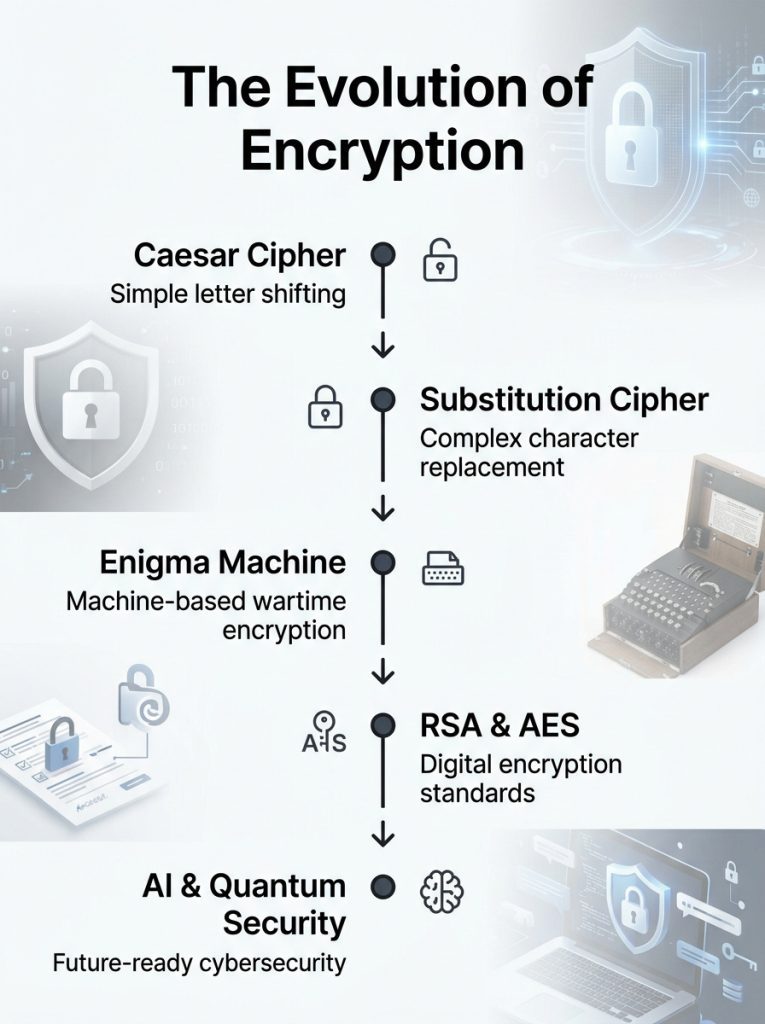
You can trace the most significant developments in digital security by looking at the path from the old Caesar cipher to today’s sophisticated encryption. It is a far cry from the basic letter-shifting of yesteryear; that simple technique has come to underpin the whole of modern cybersecurity. Over the years, we have seen substitution systems and wartime contraptions give way to public key cryptography and AI-driven defenses.
But the threats are just as dynamic. With phishing, ransomware, data breaches, and AI-enabled cybercrime being a worldwide concern for companies, the need for robust protection has never been greater. Encryption is not the sole preserve of governments or big business anymore. You will find it safeguarding your private messages, cloud storage, online banking, and shopping.
Want to add more solid quantum-proof security to your digital security?