
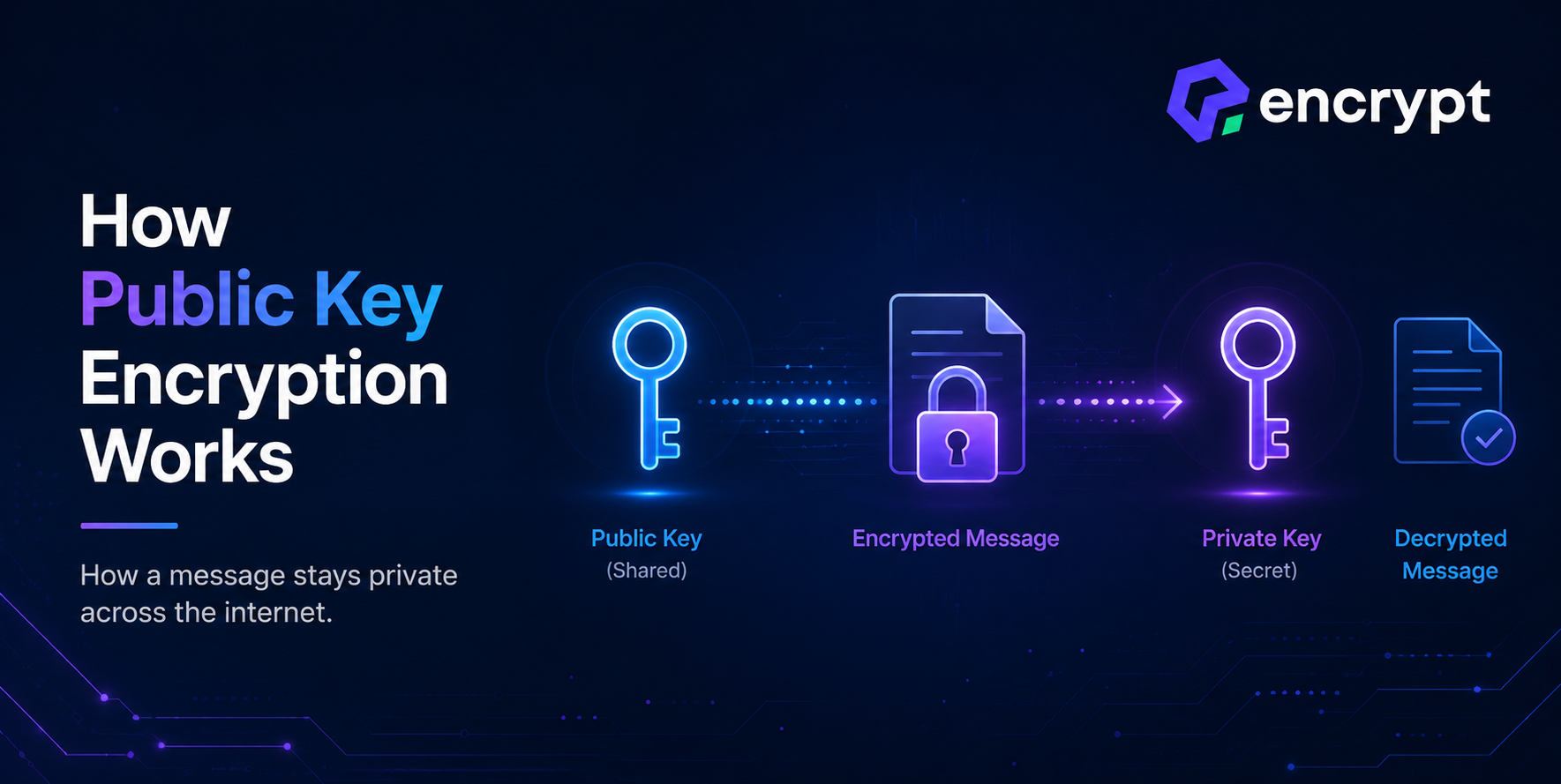
Encryption is a word that carries some complexity, yet the principle behind it is as straightforward as they come. Consider the routine of an online purchase or logging into your bank account, or even when you send off a private message; in each case two mathematical keys are quietly at work to put a shield around your data. You do not need a background in computer science to understand it. Once you get beyond the jargon, public and private key cryptography is quite intuitive.
This guide will simplify the distinction between the two, show how they secure information, and highlight your existing dependence on them.
First, What is a “Key” Anyway?
Before setting the two types up for a side-by-side comparison, it is helpful to have a firm grasp on the role of a key. At its simplest, encryption is a matter of converting readable data, or plaintext, into something that looks like random noise; the key is what controls the process. Should one run the same plaintext through an algorithm with a different key, the results will be altogether distinct.
Think of the key as your instructions for both locking and unlocking a message. Without the proper one, the encrypted output is pure gibberish. That is a concept worth keeping in mind as we go over the methods below.
The Two Types of Encryption Keys
Modern security relies on two distinct approaches to keys. They solve different problems, and understanding each one separately makes the comparison far clearer.
Private Key Encryption, the Original Approach
There is an oldness to symmetric encryption, also known by its other name, private key encryption. It is the older of the two and works simply: the same shared key locks a message and then unlocks it. The obvious corollary is that whoever has the key can read the data, which makes keeping it secret essential.
The contents remain safe, just as a physical key secures or grants access to a lockbox, as long as copies are kept in trusted hands. The approach also has its efficiencies. Because the mathematics involved are not taxing, it is fast and handles large files or real-time traffic without trouble.
There are well-documented flaws in the method, however. Before any confidential exchange can take place, the parties must come to an agreement on a key. Whether delivered by hand, by mail, or posted online, it cannot be ruled out that an eavesdropper may obtain it. A compromised key can undo the whole system. In fact, for centuries this issue of risk-free distribution was what limited secure communication to people who could get together and make the necessary arrangements face to face.
Public Key Encryption Solves the Sharing Problem
The advent of public key encryption in the 1970s was a turning point, thanks to the mathematicians who put forward this form of asymmetric cryptography. It put an end to the need for a single shared secret by giving every individual a pair of associated keys: one public and one private. While they are tied together mathematically, it is not feasible to derive one from the other.
There is a clear division of labor between the two. The public key may be distributed without restriction, whereas the private key is kept under wraps by its owner. They are designed to work in opposition; data secured with the public key will yield to nothing but the corresponding private key.
Consider an open padlock. One can give out as many as one wishes, and anyone can fasten one to a box for you. Yet only you can open them. In much the same way, a stranger can dispatch something to you in confidence without the two of you ever having met. It was that kind of innovation that enabled secure communication on the open internet.
How Public and Private Keys Work Together
The real power of asymmetric cryptography shows up when the two keys cooperate. They deliver privacy and proof of identity at the same time.
The Encryption Process Step by Step
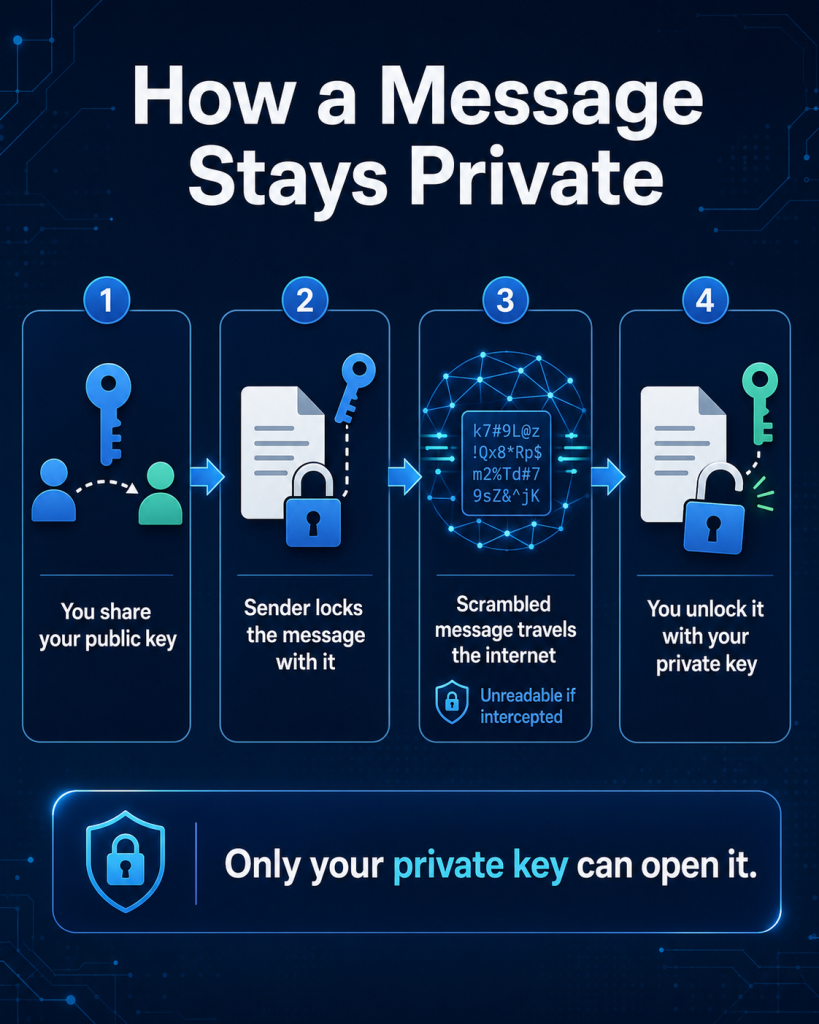
The process is easier to follow as a short sequence. Suppose someone wants to send you a confidential message:
- You publish your public key so anyone can find it.
- The sender uses that public key to scramble the message into ciphertext.
- The scrambled message travels across the internet, where it looks like nonsense to anyone who intercepts it.
- You receive it and use your private key to unlock the original text.
Because only your private key can reverse the process, interception no longer breaks the system. An attacker may copy the message in transit, but they still cannot read it. That elegant division of labor is the reason asymmetric cryptography underpins so much of modern security.
Beyond Secrecy: Proving Who You Are
Confidentiality is not the only aspect of public key cryptography. There are digital signatures as well, a way of vouching for one’s identity that involves the keys changing roles.
To put this into practice, you would use your private key to sign a message and leave your own mark. Anyone who wants to verify it can use the public key. A proper signature leaves the recipient in no doubt about the message’s origin or that it has not been tampered with; after all, only you have the private key, so no one else can claim authorship.
It is how software updates are handled. Before a device will take on an update file, it must first examine the developer’s digital signature. That is the only way to keep an attacker from slipping in some malicious code. Ultimately, having both the public and private keys available provides a degree of privacy as well as trust.
Where You Already Rely on These Keys
You need not search far to come across this technology at work. In truth, it is in constant use, and one may well be oblivious to it. A few ordinary examples will show how widespread it has become.
There are secure websites, for example. The padlock displayed in the browser is there because of a TLS handshake, an asymmetric cryptographic procedure that vouches for the site and puts in place a private channel.
Chat apps are another example. Everyone uses them to encrypt their conversations, keeping the exchange private between the parties concerned.
When it comes to cryptocurrency, possession of a digital asset is as simple as having the private key. The public address is for others to make transfers with.
Email security and the protocols for logging in operate on the same principle, making use of signatures and key pairs for the authentication of the user or sender.
Understanding the mechanics behind such matters is not a simple task. Given how deeply they are embedded in the day-to-day, the knowledge has worth of its own, not just as some academic formality.
Public vs Private Key: A Quick Comparison
To clarify the distinction, here is how the two approaches compare across the most important qualities:
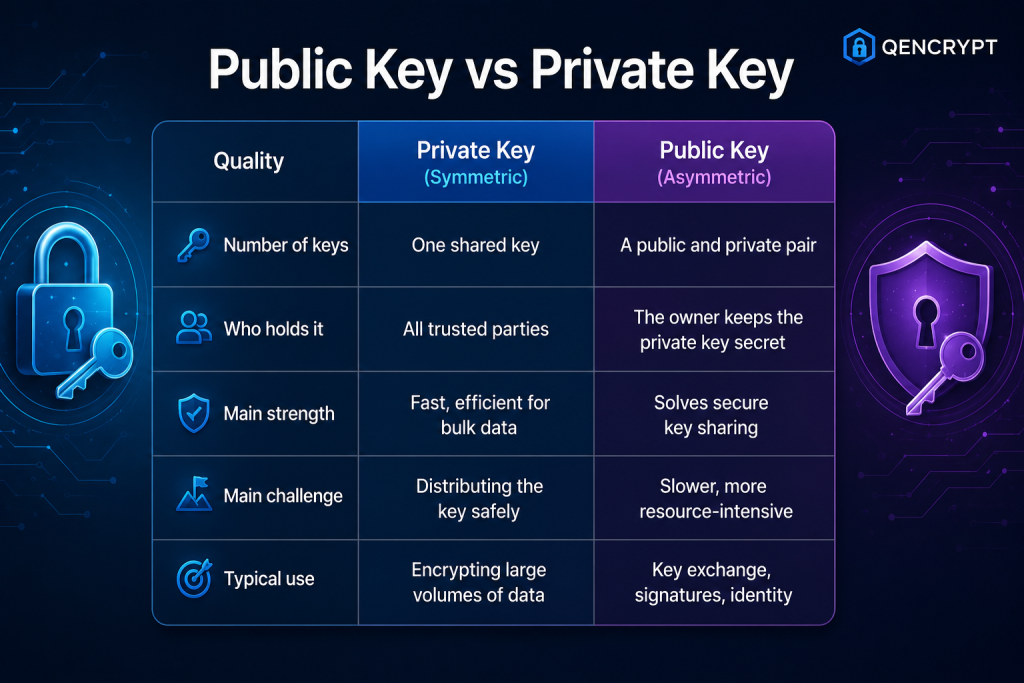
In practice, most real systems combine both. Public-key cryptography handles the risky introduction between strangers, then hands off to fast symmetric encryption for the heavy lifting. You get the best of both methods working together.
The Challenge on the Horizon
There is one limitation that many introductory guides skip, and it deserves attention. The security of today’s most common public key methods, such as RSA and elliptic curve cryptography, rests on math problems that ordinary computers cannot solve quickly.
Harvest Now, Decrypt Later
There is a very real possibility that quantum computers will one day solve these kinds of problems much faster. It has given rise to a current preoccupation with what is termed “harvest now, decrypt later.” The concept is simple enough for an adversary: make off with your encrypted data and put it on ice until such time as quantum tech is advanced enough to break the code. For that reason, any information you cannot afford to have in the wrong hands, whether medical or financial records or intellectual property, is at risk if it is protected only by the old algorithms.
The Move Toward Quantum Safe Encryption
With that in mind, standards bodies have put forward quantum-resistant encryption to defend against such attacks in the future. The intent of these more recent methods is to shield long-lived data from threats that are as yet incomplete but on the horizon. When it comes to sensitive information requiring privacy for the long term, a forward-looking form of protection has become a necessity rather than an option.
The Bottom Line
There is no reason for encryption to be an impenetrable black box. The concept is straightforward once one grasps the dynamic of a public key to lock and a private key to unlock; from there, the whole scheme makes sense. Public keys handle the safe sharing of secrets while private keys are all about speed, and in combination they put a safeguard on virtually all your online activity.
Yet the foundations of encryption are in flux, making it essential to have future-proof protection. It is only sensible to opt for tools that will serve you going forward rather than what was adequate in the past.
For those seeking encryption capable of withstanding the threats of tomorrow, even in a quantum world, QEncrypt offers a look at how their modern, quantum-safe approach is put to work.