
Without robust cryptography, there is no data security, yet many people do not understand how it works. Public Key and Private Key Cryptography are distinct ways of going about information protection, and they are not interchangeable in the problems they address; one is predicated on a shared secret, the other on a pair with a mathematical bond. The difference is so significant that anyone responsible for business records or sensitive emails and files should appreciate it.
We have put together this guide to set out both methods in terms anyone can follow. It will clarify how each system works, where it is best applied, and why the distinction is fundamental to encryption today.
Understanding Encryption Basics
One should grasp what encryption is all about prior to making a comparison of key types. In essence, it turns plain data into unreadable code; the original message can be restored and read only by someone with the right key. It is this straightforward concept that is the safeguard for financial transactions, passwords, files, and email on a daily basis.
What Is Cryptography?
Cryptography is the science of securing information through mathematical techniques. It keeps data confidential, verifies identities, and prevents tampering. Every encryption system, whether simple or advanced, relies on some form of a key. That key determines who can lock and unlock the data.
Why Businesses Need Strong Security Methods
There is a great deal of sensitive information that companies have to put in order every day. Whether it’s internal communications, financial statements, or customer records, companies must safeguard them. Without sound security, attackers can easily access the data. One way to reassure clients and partners is to adopt appropriate cryptography, which helps reduce risk. Then there are the regulators who want to see evidence of robust data protection from businesses more than ever. Put it this way: a breach will be a stain on a company’s good name for years to come. Thus, when a crisis strikes, leaders can act quickly and wisely if they understand what tools they have.
What Is Public Key Cryptography?
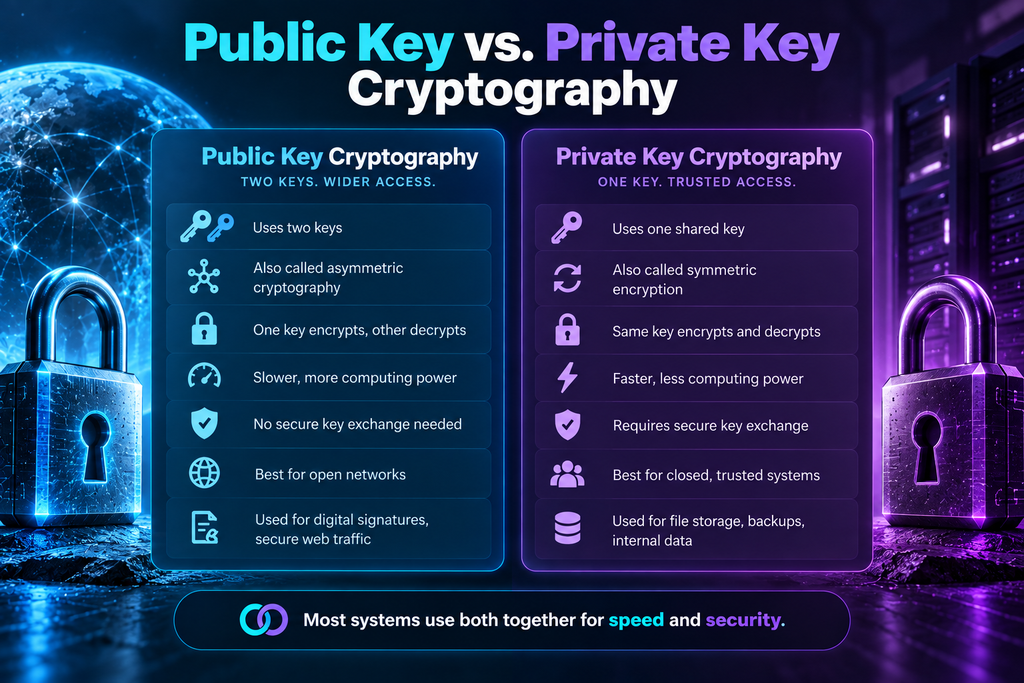
Public key cryptography, also called asymmetric cryptography, uses two separate keys. One key is public and shared openly. The other key stays private and known only to its owner. These keys are mathematically related, but one cannot be easily derived from the other.
How Public Key Cryptography Works
The public key is available for all to put a message in cipher. To read it, one requires the corresponding private key. In this way, there is no need to exchange a secret key beforehand. Digital signatures are accommodated as well, providing assurance of the sender’s identity.
Common Use Cases
The connections to a website, the integrity of digital signatures, and secure email are all put in place by public key cryptography. Online identity verification is another matter that it handles well. The use of two keys means that even on an open network where strangers have to make contact in safety, there is robust protection to be had.
One will find banks, the healthcare sector, and government bodies putting this technology to use every day. In fact, should a padlock appear in the browser, one can assume public key cryptography is at work behind the scenes. It is an unobtrusive but steady form of security that requires nothing of the user to see that routine online business is conducted safely.
What Is Private Key Cryptography?
With private key cryptography, or symmetric encryption, as it is more commonly known, all parties use one and the same key. The identical key is required of the sender and receiver alike for the purposes of encrypting and decrypting. Given its speed and efficiency, the approach is well suited to handling sizeable amounts of data.
How Private Key Cryptography Works
Data is locked and unlocked with one and the same key, so it has to be in the possession of both parties prior to any communication. There is no protection for the information should the key be obtained by someone who ought not to have it; he would be able to read all of it. For that reason, the sharing of keys in a secure manner is indispensable.
Common Use Cases
Private key encryption in use for everything from file storage and safeguarding databases to the communications of an internal system. Provided there is a means of exchanging the key in advance and a measure of trust between the parties, it is an effective method. The speed with which it can be applied enables the expeditious encryption of sizeable files.
Organizations often use it for backup, archived data, or internal messaging. And because it is less taxing on the processor, even a resource-limited device has no trouble with it. Overall, private key encryption is a sensible choice for everyday use.
Public Key and Private Key Cryptography: Key Differences
A side-by-side look at public and private key cryptography will show what each has to offer in the way of strengths and their limitations as well. They are two parts of a comprehensive security plan, each with its own role; together, they make up for deficiencies that one or the other could not address alone.
- Speed and Performance
The relative simplicity of the mathematics at work means private key cryptography is a quicker way to handle data. One has to expend more computing resources with public key cryptography to deal with its pair of linked keys rather than a single shared secret.
- Key Distribution
Then there is the matter of distribution. A private key system will need a secure channel to put the key in place ahead of time, which can be something of an impediment on a large network. Public key systems are not so encumbered; they avoid this issue by allowing the public key to be distributed without loss of security.
- Security Level
For open lines of communication between parties that do not know each other, public key cryptography is typically the more robust form of protection. In a closed system of users who already have a level of trust, a private key is preferable. The surest way to safeguard everything is to make use of both.
Real-World Application
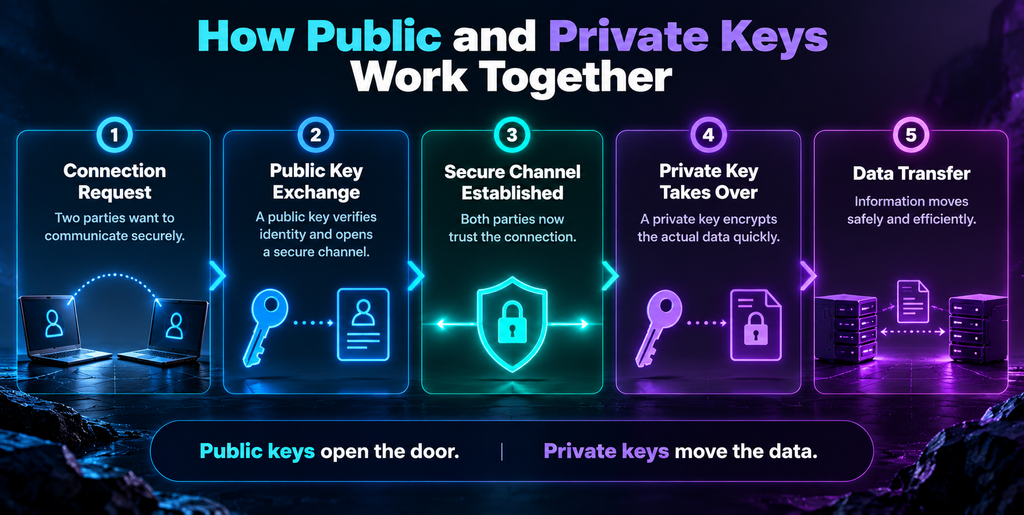
Take the case of a confidential document that a client receives for the first time. Here public key cryptography is employed to put in place a secure channel after it has confirmed the identities of both parties. Private key methods then do the rest, encrypting the file at speed so as not to impede the transfer. It is this kind of layering that makes the combination of the two indispensable to many a modern system; one will find the same sort of thing going on behind the scenes with cloud storage or an online banking and messaging app.
Managing Keys Safely
No matter what method you put in place, you cannot overstate the importance of key management. A lost private key is gone for good, and with it goes any access to the data it encrypted. To mitigate such risk, one must limit access, put keys where they are secure, and see to it that they are rotated from time to time. There is a move among organizations to let purpose-built software does the work of these things on its own; this not only bolsters protection but also takes human error out of the equation.
Then there is the training of employees. It is essential that staff have no ambiguity as to how to go about dealing with sensitive keys properly. If someone is careless and puts a key over an unsecured line, they can waste months of planning. Audits on a regular basis will uncover any chinks in the armor before an attacker does. In the end, a sound combination of software and the right habits make for a far more robust defense.
Which Method Should You Use?
It is the norm for modern systems to employ a combination of the two. One will implement a public key exchange to open up a secure channel, after which the private key is called on for the data transfer proper, as it is the quicker option. In this way the hybrid model offers a good compromise between speed and robust identity verification.
For the most part, software applications will take care of the cryptography without any intervention. QEncrypt from MindSuite is a good example of file protection. Yet understanding the concepts at work is helpful; it clarifies what these tools do and why settings such as encryption type or key length matter.
Frequently Asked Questions
1. What is the main difference between public key and private key cryptography?
With public key cryptography, there are two distinct keys at work, whereas the private key variety relies on a single shared key for encryption and decryption.
2. Is public key cryptography more secure than private key cryptography?
In an open network public key cryptography will generally be the more secure option, but in a closed system where trust is not an issue, private key cryptography is still very much to be relied upon.
3. Can these two methods work together?
One will find that several systems make use of both. A secure link is put in place by the public key approach, and from there the private key is called on for the quicker transfer of data.
4. Why is private key cryptography faster?
The mathematics at work in private key cryptography is of a simpler nature, which in turn means less processing time, an advantage to be had when one has to put through large volumes of data in short order.
5. Do I need advanced technical skills to use encryption tools?
As for the rest, there is no need to concern oneself with it. Programs like QEncrypt handle key generation and management as part of their routine. Yet some familiarity with the workings of public and private keys helps the user ensure that they properly understand the settings and permissions.
Final Thoughts
There is a distinction in how public and private key cryptography go about the business of safeguarding sensitive data, even if the result is the same. One will be preferred for speed and simplicity; the other for flexibility and identity verification. It is useful for an individual or a company to have these differences in mind when deciding on the proper course of protection. With the way data threats are changing, a grasp of the fundamentals of encryption is more of an asset than ever. An awareness of how such systems work will lead to better security habits, whether for personal files or those of the firm. There are tools on hand that do not obscure the essentials, yet they make good protection available to all by making the encryption process less of a chore.
To be able to make sound security decisions down the road, it pays to get to know these concepts. In the final analysis, a well-considered approach to cryptography means your digital communications are safer and data storage is more robust, which is something to have whether at home or running a business. For those with sensitive information to contend with, it is also