

It is not only the big corporations and government bodies that have to worry about data privacy these days. Anyone making use of e-commerce, messaging apps, email, cloud storage, or online banking is reliant on encryption in their day-to-day life.
With cyberattacks becoming more sophisticated and far reaching, companies are being forced to put more muscle into their cybersecurity and think ahead to the advent of quantum computing.
That sort of pressure has led to a fresh look at the old question of symmetric versus asymmetric cryptography.
For a business intent on keeping customer data safe, staying compliant and minimizing risk down the road, it is imperative to know what you are dealing with in terms of the strengths and limitations of these various models.
What Is Encryption and Why Does It Matter?
What encryption does is take information in plain view and turn it into a code that is unintelligible to anyone without permission. The only way to get at the data is to have the right cryptographic key to decrypt it.
According to IBM, the average global cost of a data breach reached $4.88 million in 2024, marking one of the highest levels ever recorded.
When discussing modern encryption systems, two major cryptography types dominate the conversation:
- Symmetric cryptography
- Asymmetric cryptography
Both methods secure information, but they solve different cybersecurity challenges.
What Is Symmetric Encryption?
Symmetric encryption uses one shared secret key for both encryption and decryption. The sender and recipient must possess the same key to access the protected data.
Because it relies on a single key, symmetric encryption processes information rapidly and efficiently.
Common Symmetric Encryption Algorithms
Several widely used symmetric algorithms include:
- AES (Advanced Encryption Standard)
- DES (Data Encryption Standard)
- 3DES
- Blowfish
- Twofish
- ChaCha20
Among these, AES remains the global industry standard.
Why Symmetric Encryption Is So Fast
Symmetric encryption is significantly faster than asymmetric encryption because it uses less computational power.
Key reasons for its speed include:
- Simpler mathematical operations
- Lower CPU usage
- Reduced latency
- Faster processing for large data volumes
Advantages of Symmetric Encryption
- Faster Data Processing: Symmetric algorithms can encrypt massive datasets quickly, making them ideal for real-time applications.
- Lower System Resource Usage: Organizations can secure data without requiring expensive hardware upgrades.
- Strong Protection Against Brute Force Attacks: AES-256 currently remains highly resistant to brute-force attacks. Experts estimate that breaking AES-256 with classical computing would take billions of years.
- Better for Large-Scale Encryption: Large enterprises handling extensive customer records often rely on symmetric encryption for operational efficiency.
Challenges of Symmetric Encryption
Although symmetric systems are highly efficient, they also create several challenges.
- Secure Key Distribution: The largest problem involves securely sharing the secret key between parties. If attackers intercept the key during transmission, the encrypted data becomes vulnerable.
- Scalability Issues: Managing unique keys for thousands or millions of users becomes difficult for large organizations.
- Limited Authentication Features: Symmetric encryption focuses on confidentiality but does not naturally verify user identity.
What Is Asymmetric Encryption?
Asymmetric encryption uses two mathematically related keys:
- A public key for encryption
- A private key for decryption
Unlike symmetric encryption, users never need to share the private key publicly.
This approach improves trust and secure communication across open networks.
Common Asymmetric Encryption Algorithms
Popular asymmetric algorithms include:
- RSA
- ECC (Elliptic Curve Cryptography)
- Diffie-Hellman
- ElGamal
Advantages of Asymmetric Encryption
- Safer Key Exchange: Public keys can be shared openly without exposing private keys. This significantly reduces the risk of intercepted credentials.
- Digital Signature Support: Asymmetric cryptography enables digital signatures that verify authenticity and integrity.
- Improved Scalability: Organizations can manage large user networks more effectively without maintaining countless shared keys.
- Better Authentication: Asymmetric encryption helps verify that users and systems are legitimate.
Challenges of Asymmetric Encryption
Despite its advantages, asymmetric encryption has limitations.
- Slower Performance: Complex mathematical calculations require significantly more processing power.
- Higher Resource Consumption: Servers handling thousands of encrypted requests may experience performance strain.
- Greater Quantum Vulnerability: Most current asymmetric algorithms could eventually become vulnerable to quantum computing attacks.
Symmetric Cryptography vs Asymmetric Cryptography: Key Differences
Understanding the differences between these two systems helps businesses choose the right security methods for their needs.
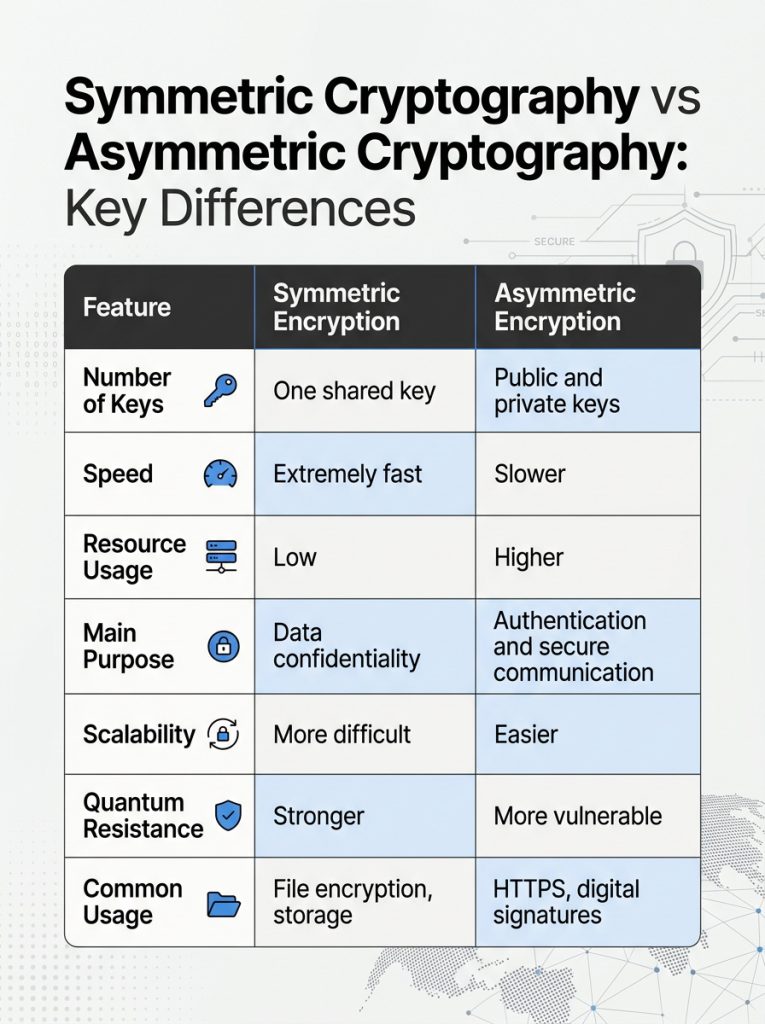
This encryption comparison highlights why most organizations use both systems together rather than choosing only one.
The Quantum Computing Challenge
Quantum computing represents one of the biggest future threats to current encryption systems.
Traditional computers process information sequentially. Quantum computers, however, can perform certain calculations exponentially faster.
This creates major concerns for existing cryptographic algorithms.
Why Quantum Computing Threatens Asymmetric Encryption
You will find that most asymmetric systems rely on mathematical conundrums that a classical computer cannot solve. But with a quantum system executing Shor’s algorithm, you could see the end of RSA, ECC and Diffie-Hellman.
That in turn puts at risk everything from your digital signatures and secure web sites to the financial infrastructure and government channels of communication. The scale of the problem is such that the World Economic Forum has put the number of digital devices that will need post-quantum security overhauls at close to 20 billion.
Why Symmetric Encryption Is More Quantum Resistant
When it comes to quantum threats, symmetric encryption is not as exposed. Grover’s algorithm can certainly erode the strength of a key, yet you are still very well protected with a sufficiently large one. Take AES-128 for instance; under that kind of attack, it is tantamount to a 64-bit key. An AES-256, on the other hand, offers formidable security. That is why you will find most cybersecurity professionals advising an upsize of your symmetric keys in their plans for quantum readiness.
The Rise of Post-Quantum Cryptography
To prepare for future threats, organizations are rapidly adopting post-quantum cryptography (PQC).
PQC algorithms are designed to resist attacks from both classical and quantum computers.
In 2024, NIST finalized several major post-quantum cryptographic standards to support global cybersecurity migration.
Key Post-Quantum Technologies Changing Cybersecurity
Several advanced technologies are now shaping the future of encryption.
- CRYSTALS-KYBER
CRYSTALS-KYBER is designed for secure key exchange in post-quantum environments.
Benefits include:
- Strong quantum resistance
- Faster performance
- Lower bandwidth requirements
- Enterprise scalability
NIST selected KYBER as one of its primary post-quantum standards.
- CLASSIC McELIECE
Classic McEliece is known for extremely strong security and long-term reliability.
Key strengths include:
- Decades of academic research
- High resistance against known attacks
- Strong stability for secure communication systems
- CRYSTALS-DILITHIUM
Dilithium provides secure digital signatures for post-quantum systems.
Common use cases include:
- Software authentication
- Secure document verification
- Enterprise identity systems
- FALCON
FALCON focuses on smaller signature sizes and high efficiency.
This makes it useful for:
- Mobile applications
- IoT devices
- Enterprise-scale deployments
- SPHINCS+
SPHINCS+ uses hash-based cryptography instead of traditional mathematical structures.
Advantages include:
- Strong security guarantees
- Reduced dependence on complex algebraic systems
- Long-term reliability
Which Encryption Method Is Safer Today?
The answer depends on the situation.
Symmetric Encryption Is Better For:
- Fast encryption
- Large data protection
- Cloud storage
- Enterprise databases
- Real-time communication
Asymmetric Encryption Is Better For:
- Identity verification
- Secure internet communication
- Key exchange
- Authentication systems
The Real Winner: Combined Security
Rather than replacing one another, both encryption models work together to secure modern infrastructure.
The strongest cybersecurity strategies now combine:
- Symmetric encryption
- Asymmetric encryption
- Post-quantum cryptography
Final Thoughts
What was once a matter of technical preference in the debate between symmetric and asymmetric cryptography has given way to something more consequential. Today it is a cybersecurity imperative with global ramifications for everyone from individuals to governments, financial institutions, and businesses.
There is no denying the value of either approach. Symmetric encryption is still unmatched for its speed and scalability, not to mention how well it stands up to new quantum threats. At the same time, you cannot do without asymmetric encryption if you want to ensure digital trust and proper authentication over the internet. Yet the specter of quantum computing is hastening a move to post-quantum security.
Qencrypt is one platform putting advanced post-quantum tech at the disposal of organizations so they can plan. Their suite includes CRYSTALS-KYBER, FALCON, SPHINCS+, CLASSIC McELIECE and CRYSTALS-DILITHIUM. As standards change, making a proactive investment in security that can resist quantum attacks will be key to safeguarding your most sensitive data for the foreseeable future.